


What began as a labor of love has quickly turned into the premier publishing outlet for baseball literature. The Twin Bill is an online and print literary journal specializing in fiction, nonfiction, and poetry concerning baseball. These writings go beyond game recaps and surface level observations to dive deeper into what makes baseball a lens for the writer’s perspective. As the current creative nonfiction editor of The Twin Bill, I sat down with Scott Bolohan, founder and editor-in-chief, to discuss Early Innings, the magazine’s first-ever print anthology.
This interview has been edited for length and clarity.

Malavika Praseed
Scott, I’d love it if you could give us a bit of the origin story for The Twin Bill. Obviously I’m part of the journal now but I wasn’t when it began.
Scott Bolohan
About five years ago when the pandemic hit, I was out of work like a lot of others, and living in Manhattan meant paranoia was high. We [Scott and his now-wife] ended up leaving the city and settling into a friend’s guest house in Massachusetts, and the first thing I wanted to do was watch Ken Burns’s Baseball. I’d seen bits of it as a kid but never sat and watched the entire thing. We spent the first few days of the pandemic doing that and I remember thinking, ‘I wish there was somewhere I could write about this experience.’ I have an MFA and a journalism background, so I thought, why don’t I give this a try? I bought the website and an influx of submissions came in, I recruited a few friends from grad school to be our first editors, and it’s just grown from there. I taught myself what I needed to know, and over time we added more things. Why not recruit illustrators? Why not a podcast? An anthology?
Malavika Praseed
That sounds like any passion project, along with an inability to say no to yourself! Anyway, it’s remarkable how much growth you’ve achieved in only five years.
Scott Bolohan
We hardly even advertise anymore and we still have a steady influx of submissions every issue. Clearly people are reading this, despite how niche it is. A lot of the credit goes to what we’re able to offer. Commissioned illustrations, a podcast invitation to read their work, paid publication, a lot of places aren’t able to offer those things. I’m lucky that the money hasn’t been an issue, since that’s what causes a lot of journals to fold. Now with the anthology, it’s so gratifying to contributors to have something tangible to hold.
Malavika Praseed
I know for me, when I first submitted to The Twin Bill, I was so relieved to find an outlet for the prose I wanted to write. Often it seems that sports literature is conflated with sportswriting, you only see journalism and game coverage and not writing about the sport itself. My MFA thesis was a baseball novel, and I got so many confused looks when I explained the concept. Why do you think sports literature gets a bad rap, or no rap at all?
Scott Bolohan
I’m going to be delicate here. Essentially, it’s still “jocks vs nerds” at the end of the day. Which is silly because baseball fans especially are so nerdy. It’s a very literary sport with a rich literary tradition spanning over a hundred years. Think about “Casey at the Bat”, that’s a well-known piece, and that’s a baseball poem. Now, I feel like sports literature is gaining new life through the internet, and recently there have been high-profile baseball works like E. Ethelbert Miller’s poetry or Emily Nemens’s The Cactus League. Baseball as a sport allows for time to think, it’s not fast-moving like hockey. Baseball happens in the mind and writing that focuses on that is often the strongest. Honestly, there aren’t too many places to write about sports anymore. The New York Times doesn’t have a dedicated sports section anymore, they outsource to The Athletic. I used to cover sports for a paper in Chicago, that paper later folded. And I think people who aren’t sports fans don’t understand that there’s a major component of identity to this. People feel their sports teams are part of who they are, and that leads to good writing. When it comes to baseball, the stories are what keep you coming back. The recurring characters, it’s like seasons of a TV show on a massive scale. There’s certainly more room for growth, but I think The Twin Bill is a testament to what is possible when you give people the opportunity to write about sports.
Malavika Praseed
You bring up something interesting in regards to storytelling. With TV and the internet, there’s really no need for standard sports coverage like game recaps and surface level profiles. One thing I love about The Twin Bill is how the publication explicitly looks for baseball stories where baseball isn’t the most important component. I was hoping you could speak to that.
Scott Bolohan
The game is the least important part of writing about the sport. It has to be internalized. Poetry does a good job of this especially, I was uncomfortable at first editing poetry, but I brought on one of my grad school classmates to serve as our first poetry editor. He’s English, he didn’t have a baseball background, but he could judge good poetry in its own right without being overcome by nostalgia. When you go to a game and there’s 40,000 people there, there are 40,000 different perspectives.
Malavika Praseed
Or if you’re one of the millions watching on TV!
Scott Bolohan
Right, setting can play an important role. Other characters and how you interact with them. What perspectives and images stick with you. There are lots of possibilities.
Malavika Praseed
On the topic of possibility, what do you hope for The Twin Bill going forward. We have a print anthology, a podcast, a thriving submission pool, what’s next?

Scott Bolohan
I would love to have more works in translation. Works written in Japanese, Spanish, Italian. I play baseball in Italy with Italians! It is a much more global game than we give it credit for. I also want to see more submissions from women. Lately we see a lot more women getting involved in the sport at many levels, and for a while there might have been this idea that baseball isn’t their story to tell, but that’s certainly not the case anymore. For a while we would joke that we published so many “Roberts”, a lot of old white men. Over the last couple years that hasn’t been the case. Of course, if you’re a Robert and your piece is good, obviously we’d still love to publish it. But yes, women and perspectives from other cultures and in other languages.
Malavika Praseed
What I’m curious to know is, why an anthology? Why bring something thriving online into print? Can you speak a bit to that process as well?
Scott Bolohan
Print was a scary adventure for us. At first I wondered, how hard could it be? Very hard, in fact. The costs were significant. Editing, formatting, including full-color illustrations like we have online. But print is special, it adds legitimacy. I’m holding a baseball right now in my hand, and there’s something wonderfully tangible about it. If you’re a writer, there’s something so valuable to having something tangible to hold your work. Print feels kind of like vinyl records where it’s experiencing a kind of return, especially in journalism. Most of all, it’s good for the writers and I’m doing it for the writers. I want a contributor to be able to open the anthology and find their piece and feel good about its inclusion.
Malavika Praseed
Finally, as this is the Chicago Review of Books, I understand that Chicago plays a role in your journey as a writer?
Scott Bolohan
So, I grew up in the Midwest, outside Detroit. As a kid I went to the Field Museum all the time, and I had this dream of walking down Michigan Avenue, I thought that was the center of the world. When I blew out my elbow in high school and realized I wasn’t going to play college baseball, I told myself, well, I want to go to Chicago. I went to DePaul and it felt like being immersed in this ambitious city. There was a Borders where I waited for 6 hours to ask Bill Clinton a couple of questions. Once I spent 24 hours on the L, riding multiple lines up and down, to try and write a story about it. Then I interned at the Red Eye, which was the Chicago Tribune’s commuter edition. It was really the last time something in print felt geared towards the younger generation. I started writing sports for them. I tried to write satire, play with form, create characters. I was encouraged to think out of the box, and Chicago did that for me. I still love going back. I go to Cubs games all the time. Once I paid $300 for a fake ticket to the White Sox World Series and I listened to the game in a police car. Lots of memories there.
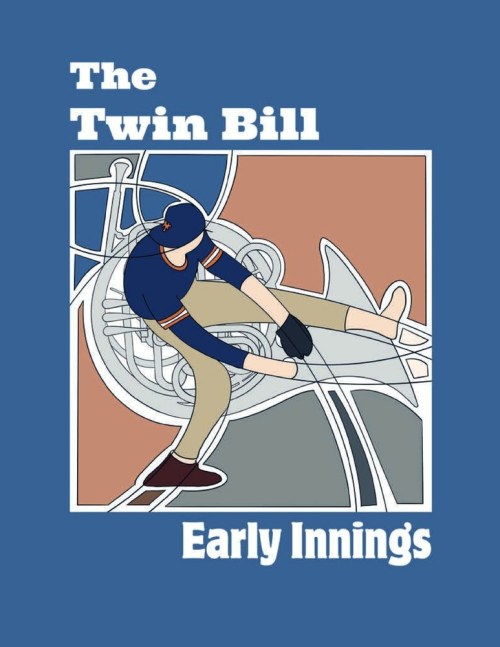
ANTHOLOGY
Early Innings
Compiled by The Twin Bill
406 Press
Published March 18, 2025


