


After last month’s election results I’ve been increasingly turning to books about activists, freedom fighters and social justice movements to reground and fortify myself in the ongoing struggle for liberation. Kingdom of No Tomorrow drew my attention for being a novel about the civil rights movements that focused on the Black Panthers. Nettie Boileau is a Haitian student attending college in Oakland who’s drawn into the world of the Black Panther Party (BPP) in 1986. This is a novel that is both a coming of age and coming into consciousness, and half of the novel takes place in Chicago where Nettie crosses paths with the Illinois Chapter of the Black Panther Party, including Fred Hampton. It’s an enthralling and revolutionary story chock full of historical details and memorable scenes. Notably Kingdom of No Tomorrow garnered a place on the 2025 longlist for the Aspen Words Literary Prize (one of my favorite literary prizes), before it was even officially published, an impressive accomplishment. The shortlist won’t be announced until March, so CHIRB readers have plenty of time to immerse themselves in an under-explored area of historical fiction and join the conversation.
Fabienne Josaphat lives in Miami and I unfortunately was on the road for my day job, so we chatted over email about Kingdom of No Tomorrow. Our conversation is below.
Ariana:
I want to start by talking about the prize you won last year. I wasn’t familiar with the PEN/Bellwether Prize for Socially Engaged Fiction but I am so glad your book introduced me to it as I now want to read all the previously awarded titles. How did you hear about the prize and what made you decide to submit?
Fabienne Josaphat:
My agent and I were both looking for a prize or opportunity to submit this book. When I learned about it, they were calling for submissions and we decided it checked all the boxes for what we wanted. I really liked that it focuses on social justice, and we felt that the theme and substance of the book qualified it for submission. I’m thrilled we did this, and I’m honestly thrilled this prize exists in the world to boost the career of authors whose stories need to be amplified.
Ariana:
I’ve long said we need more fiction about the Black Panthers so I was thrilled when I learned your book was coming out. How was your overall journey to publication and did you find any pushback?
Fabienne Josaphat:
I’ve honestly been pleasantly surprised during this journey to find that many people were interested in the subject. I think that curiosity and the growing conversation around Black Lives Matter have brought the Black Panthers out into the light again and now, there is a lot more information available. There’s been encouragement and excitement.
I do remember, however, one experience that was different. During the research and drafting process for this book, one instance in particular where I told someone what I was working on and I got a very cold reception to the idea. It was clear that he had a very skewed and negative view of the Black Panthers. This told me this person, like many others, had bought into the lies and distortions about the BPP. And yet, this experience did not dissuade me. In fact it motivated me to write the book. Through fiction, I hope to shift the collective mind to recognize the power and the incredible achievements of the Black Panthers. We must give them their flowers.
Ariana:
What books would you say Kingdom of No Tomorrow is in conversation with? Or what are 2-3 titles you’d suggest folks pair it with if they want to read more about the Black Panther Party, 1960s Haiti or female friendship?
Fabienne Josaphat:
I recently blurbed a novel called If Not The Whole Truth by Claire Arbogast which is in direct conversation with Kingdom of No Tomorrow. Same era with a white, female protagonist in the thick of movements, looking for her own way. That, in addition to the books I mention as resources in my acknowledgements, would be good companion readers – especially Elaine Brown’s A Taste of Power.
Ariana:
You have a blurb from Barbara Kingsolver on the cover of this book, and your first novel was blurbed by THE Edwidge Danticat (one of my favorite authors). Who would you say are generally your literary influences and for Kingdom of No Tomorrow in particular?
Fabienne Josaphat:
I think of Alice Walker and Zora Neale Hurston as my literary godmothers. But being of Haitian descent, a lot of my literary influences come from the Caribbean and the Americas – authors like Jacques Roumain and mostly, Jacques Stephen Alexis from my native Haiti, some of the most beautiful writers who ever lived; Guadeloupe’s Maryse Conde, Martinique’s Raphael Confiant, and magical realist writers like Jose Saramago and Gabriel Garcia Marquez from South America. For Kingdom of No Tomorrow specifically, I think of Alice Walker’s Meridian, and I’d say there are ideas and influences from Haitian authors like Jacques Roumain there….
Ariana:
Nettie attends political education classes, which were a key component of being a member of the Black Panther Party. What books would you say influenced your own political education?
Fabienne Josaphat:
I grew up with a father who was an avid reader, especially of non-fiction, and all my memories of my father are of him reading political books. Books like the biography of Muhammad Ali or Angela Davis, or books about subversive political leaders, were slowly introducing me to a sort of political education now that I think about it. I learned about revolutionary leaders like Thomas Sankara and MUAMMAR Gaddafi because of my father, and I was checking out Frantz Fanon very early, without understanding a lot of it. Now as an adult researching and writing about the Black Panthers, I see that all of this history had already been introduced to me, shaping my political education. Whether my father intended to do this, I don’t know. But I’m glad he did.
Ariana:
I appreciated that your acknowledgments section included a list of resources you used while researching the book. What’s something you learned that you wish you’d been able to include in the book? And being from Chicago where we have the Black Panther Heritage Trail and also having visited the Mini Black Panther Museum in Oakland, I’m curious if you were able to visit any BPP sites in person? Or did you have to rely on the archives?
Fabienne Josaphat:

The Black Panthers’ history is so rich and impressive, I couldn’t fit everything into it. The novel talks about their work to tackle the sickle cell anemia devastation in the African American community, as well as their work feeding children as part of the Free Breakfast Program. But I would love to discuss more of their active policing of the police in the community, and their liberation schools, for example, especially now that we are seeing the rise of book bans and a desperate attempt to suppress real history in schools.
I considered visiting both Oakland and Chicago during the writing process, but a lot of the time I had dedicated for the research was swallowed up by the corona virus. So I had to change tactics and I dug into archives, including maps, interviews, documentation, readings, etc. I’m still planning to visit though, both Oakland to see the museum, and Chicago because of Fred Hampton’s legacy there.
Ariana:
Nettie is Haitian and I was glad to see that through her backstory you showcased both revolutionary efforts in other countries (and of course Haiti was the first successful Black led revolution) and BPP’s international solidarity as their newspapers kept folks abreast of what was happening in Haiti. You could have made her Haitian American or Haitian but unaware of Papa Doc’s brutal regime. Can you talk about your decision to give her this specific background?
Fabienne Josaphat:
I wanted Nettie to be awake and aware of what’s happening, as any student in the 60’s would be at the time. Her background not just as Haitian, but a Haitian woman whose father was assassinated under a dictator’s rule, a Haitian woman whose father was a doctor and a community organizer, helped her develop a sense of collectivity and community. This makes her the ideal recruit for the Panthers. She is moving with them because she believes in this idea of a konbit, a togetherness among the people to move together to go far. This was important to me and I hope this came through, this idea that the coming together, the Pan African ethos, and the solidarity that Fred Hampton preached, were and remain necessary tools for the survival and the success of Black people in the world.
Ariana:
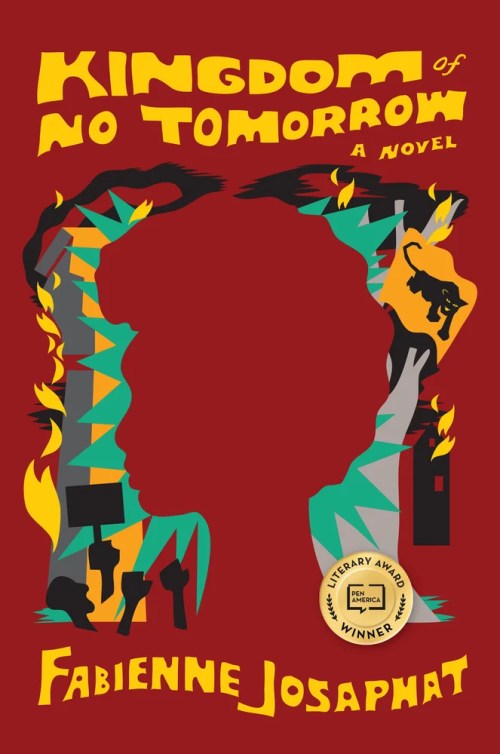
Finally, let’s talk a bit about the cover. It has a panther but also sickles and a house on fire. What inspired the cover (particular artist or imagery)? What did you want it to symbolize?
Fabienne Josaphat
The cover was a lovely surprise and I have Cathy Schott and Sunra Thompson of Algonquin Books to thank for it, and it was all their design. When they sent it over, I fell in love. The art is on point! The fire, the flag with the Panther, all the markers and symbols of protest and revolution are there and at the center of it all, a woman. It captured the narrative beautifully: a young woman in the heart of the Black Panther struggle. I am very proud of it.
Thank you so much, Fabienne!
FICTION
Kingdom of No Tomorrow
by Fabienne Josaphat
Algonquin Books
Published December 3rd, 2024


