


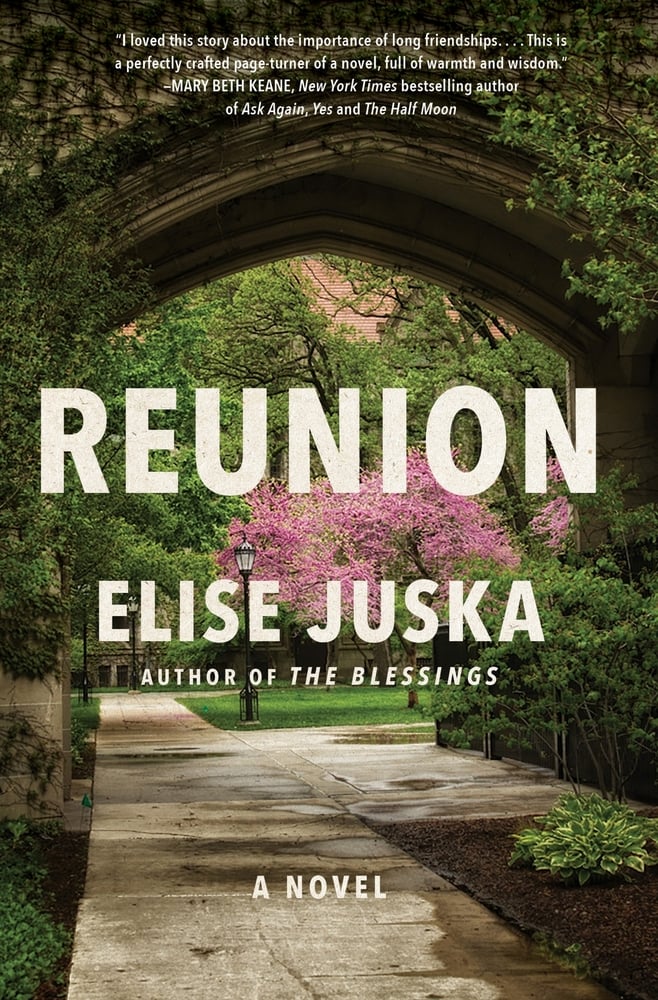
In June 2021, three friends return to Maine for their delayed 25th college reunion. Stay-at-home mom Hope, her former roommate Polly, and their friend Adam, whom they took in during freshman year after his father died, became inseparable in college. They did their best to stay in touch in the decades that followed graduation, but of course marriage, jobs, moves, and children distanced them. Against the backdrop of post-pandemic re-entry, Reunion explores the myriad ways that humans disconnect and reconnect, as Elise Juska’s fully fleshed-out characters, ensconced in middle age, revisit both the literal and emotional terrain of their youth.
What makes Reunion, Juska’s third novel, particularly compelling is the edgy fragility with which these humans emerge from the pandemic’s first year. “This was a reunion not only of people who once knew each other in college but of people staggering back into the world,” Juska writes. For some readers, the pandemic may seem still too raw to dive into for pleasure, but this novel doesn’t engage in trauma porn or medical horrors. Rather it delivers a beautiful excavation of a liminal time period that united the world in collective vulnerability. Each of Juska’s three protagonists face problems that lockdown exacerbated and that they must keep at bay to enjoy the weekend, a process that requires glossing over the truth or outright lying to their old friends. The reunion weekend—and reconnection with intuitive besties—forces confrontation.
When Walthrop, the fictional New England university at the center of this novel, reschedules its previously canceled 25th reunion, Hope pins her hopes on this weekend away as the cathartic reboot she’s been craving. “The 25th is a milestone! This is the one you show up for,” she texts her friends, setting expectations. After a difficult remote year, the former “dorm mom” looks forward to catching up with Polly and Adam and reconnecting with herself. Hope is frustrated with her selfish work-obsessed husband, baffled by her precocious teen daughter, and overtaxed by her sensitive young son’s needs. The disconnect from certainty—about her marriage, her son’s diagnosis, the future—tugs at her seams. She tries to keep it together internally by controlling her exterior: perfect makeup, stylish clothes, always a positive outlook. “It’s just one weekend,” she says smiling to her husband who resents her upcoming time away from the household. She has carefully managed the delivery of this news, like she does everything else. For Hope, the reunion represents escape, a desperately needed breath of fresh air to keep her from drowning in everyday pretense.
Adam, now an environmental lawyer, feels ambivalent about attending. True to his reputation as a go-with-the-flow friendly guy, he seems pleased to reconnect with old classmates, but behind the scenes his home life unravels. The stress of 2020 has sunk his wife, a previously peaceful and level-headed preschool teacher, into a perpetual state of anxiety ,and Adam feels unsure about leaving her with their young twins on their sprawling property in rural New Hampshire. Raised by an abusive, distant father, Adam strives to be a great dad, and a mutual adoration of their boys connects him to his wife. But with their sturdy foundation now cracked, Adam has to take a stand to save his family, and he flounders, uncertain how.
Meanwhile Polly, an underpaid adjunct professor of English and single mother of a surly, artistic teenage boy in Brooklyn, doesn’t want to revisit Walthrop. Unbeknownst to her two best friends, the college is the source of bad memories and a big secret for Polly. She is in some ways the odd woman out in the trio—the scholarship kid, the one who most starkly feels the disconnect between the privileged and the not, particularly on the tail end of lockdown. “It was an insane social experiment,” Polly muses, “how wildly the experience could vary depending on your circumstances.” And her solitude is exacerbated at home. Juska depicts the tenuous mother-son relationship with a deft hand: the intimacy and distance cohabitating in the space between them, the pandemic’s disastrous effect on teenagers and their subsequent depressive disengagement. But her son seems fired up by the climate crisis and wants to visit an environmentally active friend in Maine—they can drive together, he suggests. Her son’s happiness matters to her above all, so Polly rallies and plans to bury the past in order to weather the weekend.
The theme of disconnect between generations recurs through Reunion. Adults try to bridge the gap with their children—a generation who have “already lived through something historic, catastrophic, all the ways it would impact them still unknown,” reflects Adam. But the central generational disconnect explored in the novel is that inherent to the existential reckoning of middle age: never so aware of our mortality, never so sharply reminded of our own youth’s dreamy-eyed hopes for the future. Back on campus, these jarring reminiscences are fertile ground for discomfort and conflict. Juska has a talent for deeply immersive details and rich character development. Reunion pulls the reader in, as if we too were returning to Walthrop and assessing the state of our life. Accented by a riotous cast of secondary characters, the reunion offers the perfect setting for escalation. Unfortunately for Hope, not much goes as she’d planned. And soon, the three friends’ reconnection is disrupted by a surprising turn of events.

“Remain present in the moment,” Hope intones whenever things get tough or uncomfortable, repeating a mantra shared by her pandemic yoga teacher. If these recent years of perpetual crises—medical, environmental, economic, political, global—have taught us anything, it’s that nothing is certain. Remaining in the present moment may seem like sound advice, but for Hope it becomes permission to avoid confrontation. Avoidance has also plagued her two friends with disastrous consequences. And this is the most interesting disconnect explored in Reunion: the ruptures caused by our own choices, the denial of our desires, the ghosting of our own truths. While they used to tell each other everything, Hope, Polly, and Adam have kept secrets in the 25 years since graduation, which have shaped the inaccurate identity their friends perceive in the present. Avoidance has chipped at their authenticity. We can’t truly connect unless we are forthcoming and vulnerable—with others, with ourselves. Can friendship help us achieve reconnection? This is the novel’s central question. Like the rest of us, Reunion’s three friends struggle to exist as their whole self in a world that’s falling apart.
FICTION
Reunion
By Elise Juska
Harper
Published May 7, 2024


